Weldment to Stainless Steel Investment Casting
Franklin Precision Castings converted a nine-piece welded assembly into a single stainless steel investment casting, reducing manufacturing costs, weight, and machining requirements.
Franklin Precision Castings helped a customer redesign a fabricated trough mounting bracket as a single-piece stainless steel investment casting, achieving a 26% reduction in manufacturing costs, 32% reduction in weight, and a reduction in part count from nine components to one.
The conversion also improved dimensional consistency, reduced machining requirements, eliminated painting, and simplified production. The project earned Franklin Precision Castings an Honorable Mention for the 2017 AFS Casting Competition
The Application Trough Mounting Bracket for Vibratory Material Handling
The trough mounting bracket is a structural component used in vibratory in-line drives for material handling equipment. These systems operate at approximately 3,600 cycles per minute and are commonly used in pharmaceutical processing, food handling, small parts manufacturing, and bulk material movement.
The bracket connects the trough to the drive assembly, making dimensional accuracy and consistency essential to equipment performance.
Critical design requirements included:
- Flat mounting surfaces
- Precise flange angles and hole locations
- Consistent dimensions for proper assembly and operation
- Reliable performance under continuous vibration
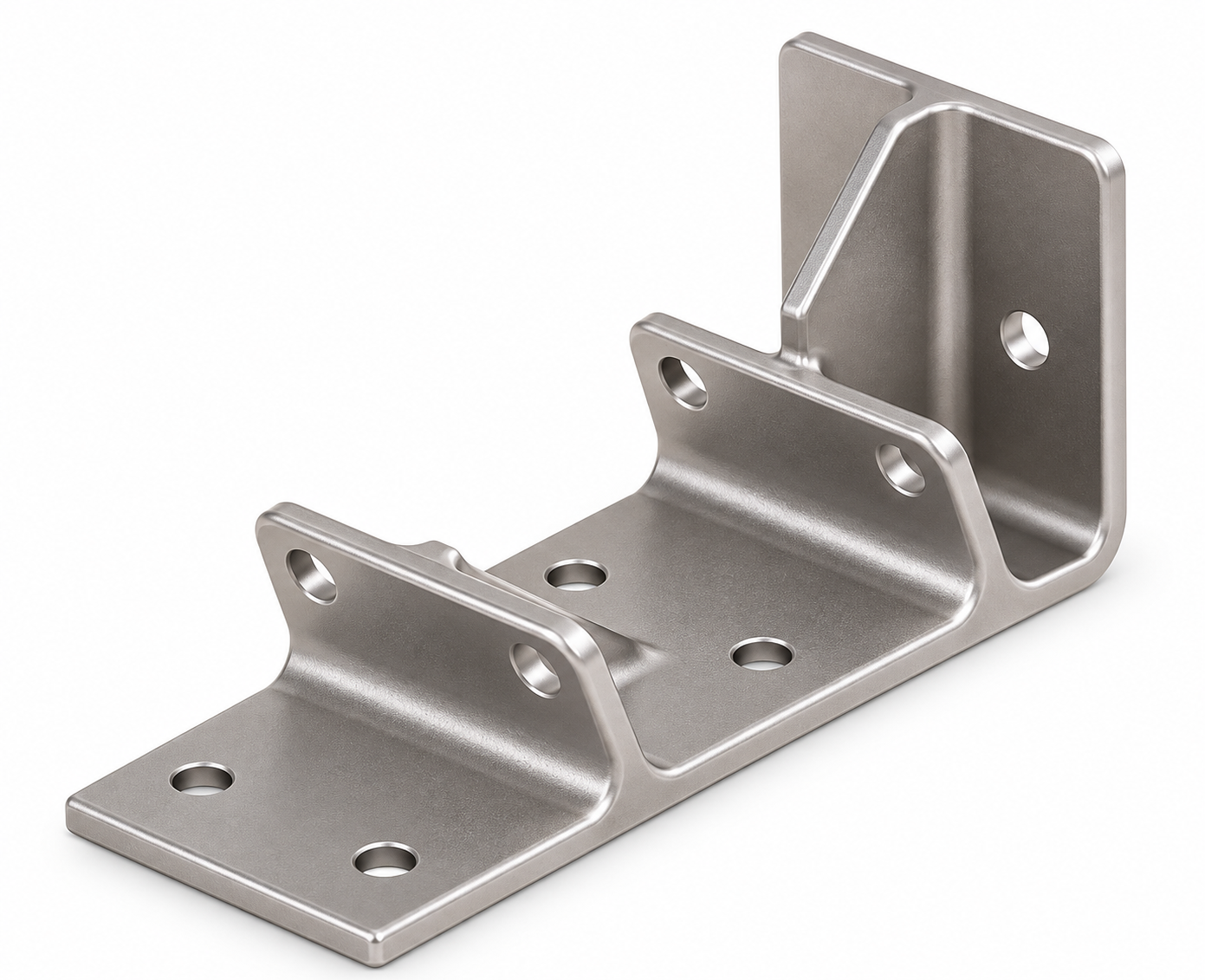
Investment Cast Trough Mounting Bracket
The original bracket was manufactured as a welded assembly using carbon steel or SAE 304 stainless steel bar stock, followed by machining to achieve the required dimensions.
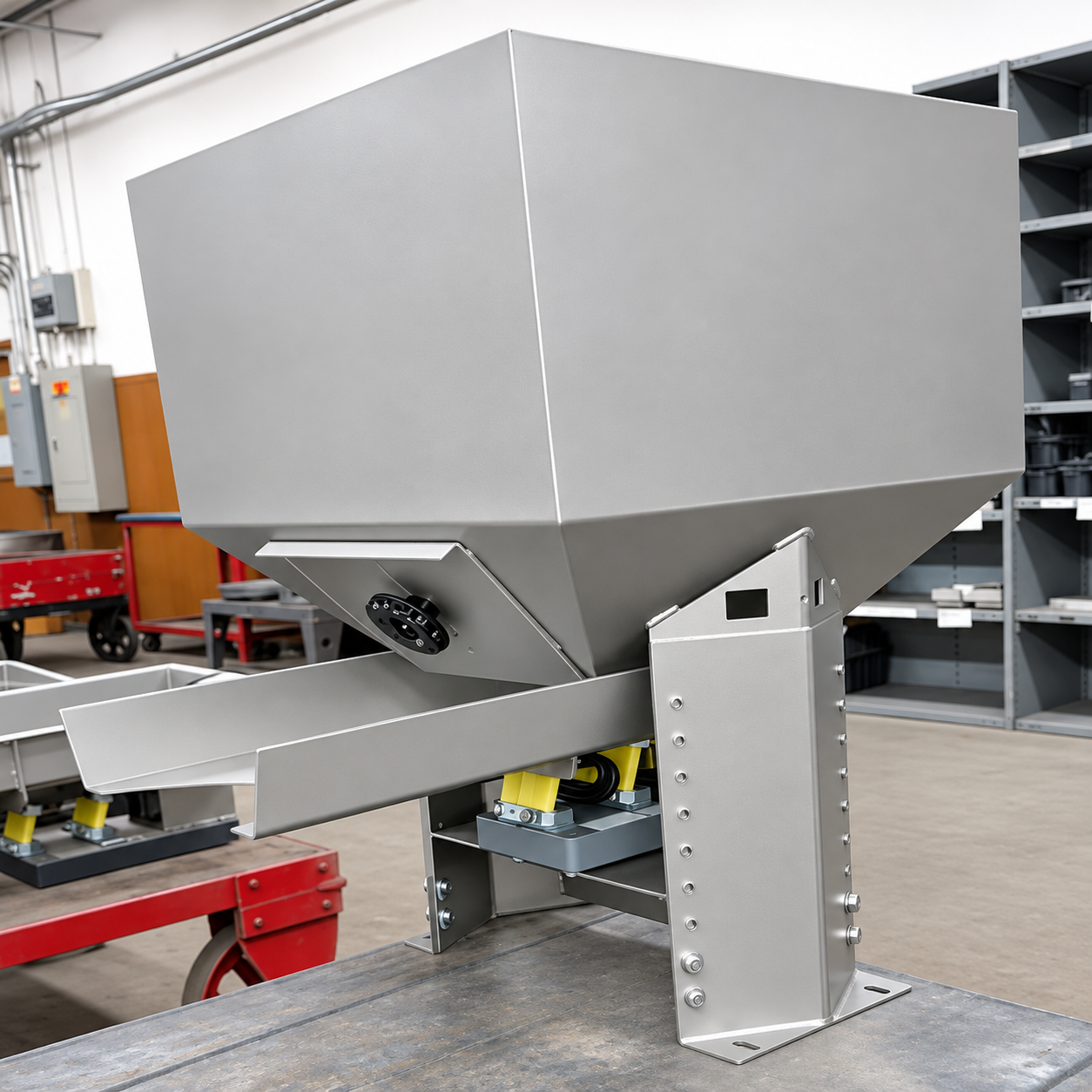
Bulk Supply Hopper used in vibratory material handling applications.
The Challenge: High Welding Costs and Dimensional Inconsistency
While welded assemblies can be cost-effective for prototypes and low-volume production, they often become less economical as manufacturing volumes increase.
The original trough mounting bracket consisted of nine individual components requiring fabrication, welding, and subsequent machining. Maintaining consistent dimensions across welded assemblies proved challenging, particularly where precise angles, flatness, and hole locations were essential.
The customer also required different material options to support end-use applications, like stainless steel for food and pharmaceutical processing environments.
As welding and machining costs increased, the customer sought an alternative manufacturing process that could improve dimensional repeatability, simplify production, and reduce overall costs.
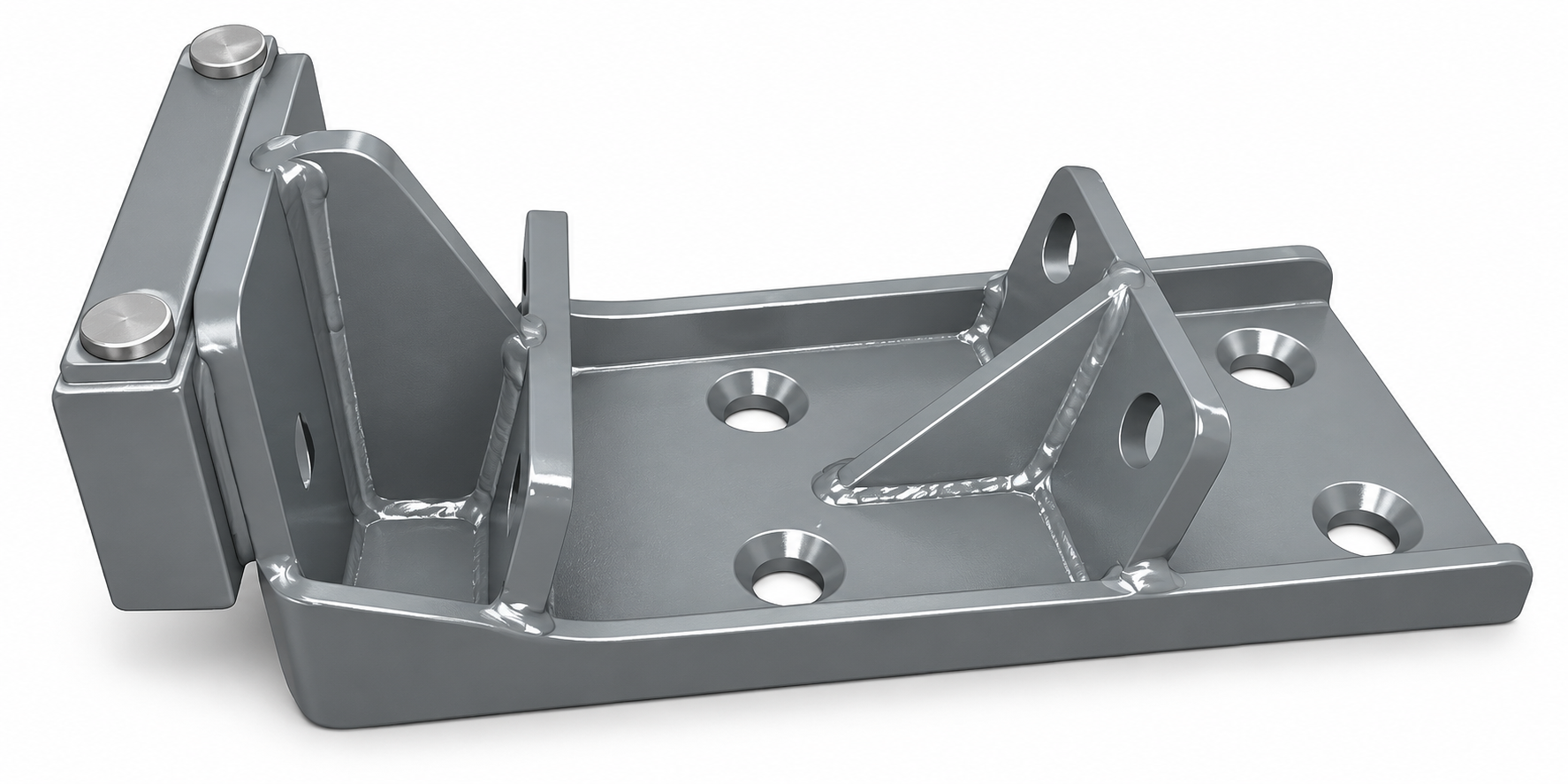
Original trough mounting bracket manufacturing as a machined and painted carbon steel weldment
The Solution: Converting a Weldment to an Investment Casting
Franklin Precision Castings worked with the customer to redesign the multi-piece welded bracket as a single-piece stainless steel investment casting.
Investment casting, also known as a lost-wax castings, enables manufacturers to product complex metal components with precise geometries and near-net shape dimensions. By consolidating multiple welded parts into one casting, manufacturers can reduce assembly operations, minimize machining, and improve manufacturing consistency.
For the trough mounting bracket, the investment casting design eliminated the need to fabricate and weld nine separate components while providing the required geometry and dimensional repeatability.
The stainless steel casting also eliminated the painting operation required for the original carbon steel version, providing a consistent surface finish.
Results: Reduced Costs, Weight, and Manufacturing
Converting the welded trough mounting bracket to a stainless steel investment casting delivered measurable improvements across manufacturing, quality, and production efficiency.
| Improvement | Result |
| Part count | Reduced from 9 components to 1 |
| Component Weight | 32% Reduction |
| Manufacturing Costs | 26% Reduction |
| Machining | Nearly Eliminated |
| Surface Finish | Improved; painting eliminated |
| Dimensional Consistency | Improved repeatability and tighter tolerances |
| Production Process | Fewer fabrication and assembly operations |
The conversion simplified manufacturing while delivering a lighter, more consistent component suited to the customer’s production requirements.
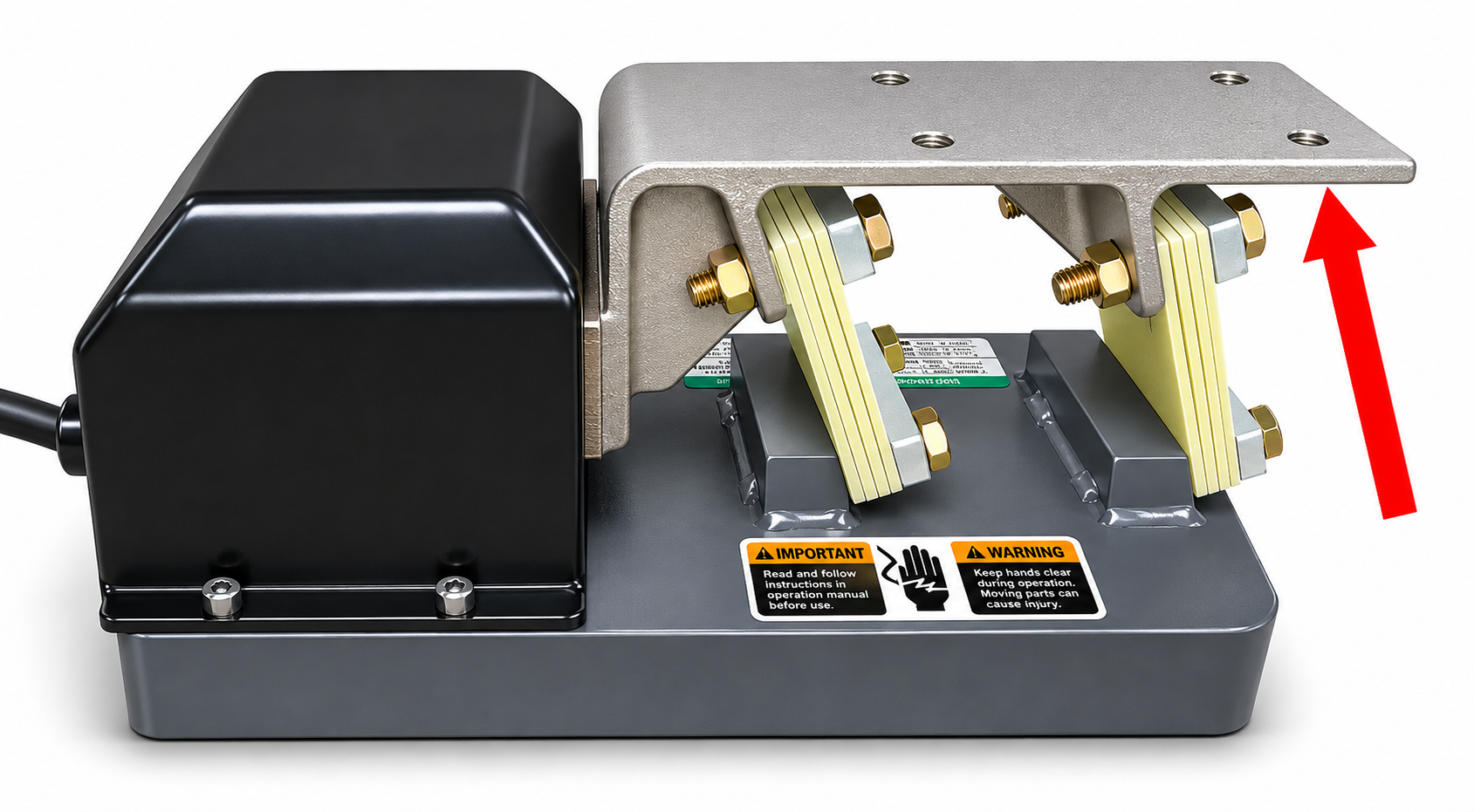
Vibratory in-line drive showing the redesigned stainless steel investment cast trough mounting bracket
When Should Manufacturers Consider Converting Weldments to Investment Castings?
Converting a welded assembly to an investment casting can offer significant advantages when components require multiple fabrication steps, complex geometries, or extensive machining.
Investment casting may be particularly beneficial for components with:
- Multiple welded of fastened parts that could be consolidated into a single castings
- High welding, assembly, or machining costs
- Tight dimensional tolerances and repeatability requirements
- Complex geometries that are difficult to fabricate
- Stainless steel or other alloys that present welding challenges
- Production volumes sufficient to offset initial tooling investment.
Although welded fabrication may remain the most economical option for prototypes and smaller production runs, investment casting can offer greater long-term value as production volumes increase.
By designing components for neat-net-shape manufacturing, companies can reduce secondary operations, improve consistency, and lower total manufacturing costs.
Explore Weldment-to-Casting Conversion with Franklin Precision Castings
Franklin Precision Castings specializes in precision investment castings for manufacturers seeking to improve component design, reduce production costs, and simplify manufacturing.
Our team works with customers to evaluate existing fabricated and welded assemblies for potential conversion to investment castings, helping identify opportunities for part consolidation, reduced machining, and improved dimensional consistency.
Updated November 3rd, 2026